
What Water Makes Possible: Swimming, Disability and Special Needs
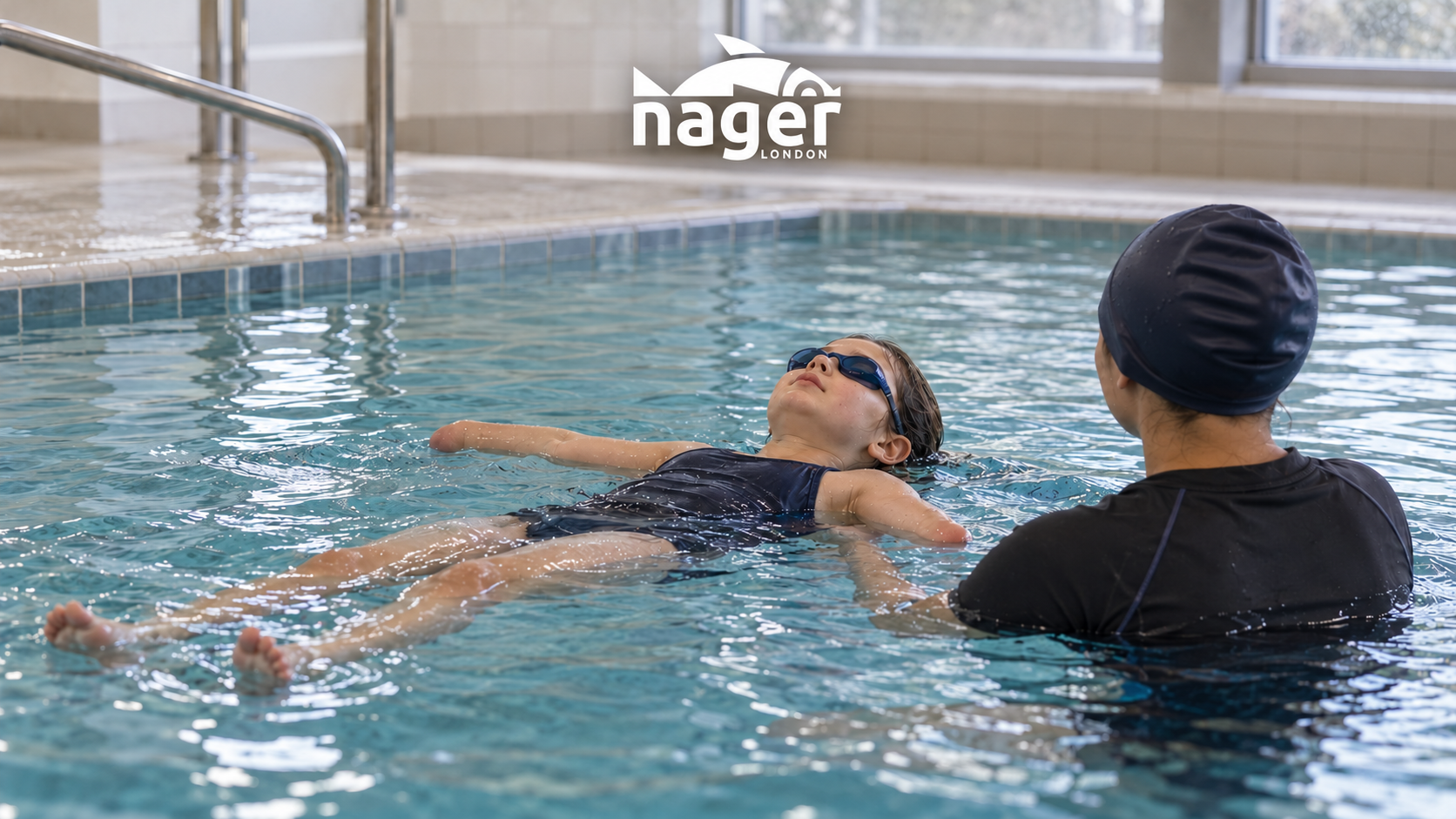
Child with a physical disability practising a supported back float during an adapted swimming lesson.
Swimming with a Disability: Ability, Independence and a Different Measure of Progress
What Water Makes Possible: Ability, Autonomy and a Different Measure of Progress
Swimming progress is usually measured in visible ways: a longer distance, a more recognisable stroke, improved breathing or greater speed.
Those measures have their place. But for a swimmer with a disability or additional learning needs, meaningful progress may begin before any of them.
It may be the discovery that they can initiate a movement, regain their balance or make a choice about what happens next. Water can offer a different setting in which to explore ability, with teaching that recognises the person as carefully as it recognises the task.
For a parent, progress may be something another person barely notices: their child entering the pool willingly, communicating that they need a pause, or repeating a movement with less support. Parents often know the effort behind these moments. Good teaching listens to that knowledge while giving the child space to discover, choose and develop their own ability.
Water Changes the Conditions
Water does not remove disability. It changes the physical conditions in which movement takes place. Buoyancy can reduce the load a person experiences through their body. Water resistance can offer opportunities to explore movement at different speeds, while contact with the water creates sensations that some swimmers find helpful and others find unfamiliar or overwhelming. For some individuals, this opens up movements that are difficult to experience on land. For others, becoming comfortable with the pool itself is the first step. The possibilities depend on more than water. The environment needs to be suitable, communication needs to be clear, and support needs to reflect the swimmer’s abilities and preferences. The person must have a way to express uncertainty, ask for a pause or decline an activity.
Being in the pool is not, by itself, the same as feeling included.
What Research Adds to the Conversation
A service evaluation published in Disabilities in September 2026 explored an individually adapted underwater programme using scuba equipment. Participants described benefits extending beyond physical movement, including a sense of belonging, greater confidence and more control over their experience.
These were reported experiences, rather than proof of treatment effectiveness. The evaluation had no control group, and the interview participants were adults. Its findings cannot be transferred directly to children’s swimming lessons or used to establish the effectiveness of a particular teaching method.
Its relevance here is a question worth carrying into teaching: are we recognising the outcomes that matter to the person, alongside the skills we can observe?
Teaching Begins with the Person
A swimming lesson may begin with floating, kicking, breathing or learning a stroke. To make those activities useful, the teacher first needs to understand how the swimmer can engage with them.
How does this person receive and process information? Which movements feel available to them today? What helps them feel secure enough to explore? What signals that they are becoming uncomfortable, tired or overwhelmed?
These questions shape practical decisions: the words we use, the pace of an activity, the amount of physical support offered and the time allowed for a response. A swimmer may complete a task with considerable prompting without yet understanding how to repeat it independently. Another may swim only a short distance but show a clearer understanding of breathing, balance or how to stop safely.
Careful teaching notices both the achievement and the support behind it. This helps us identify what has been learned and what still needs time.
Capability Has More Than One Form
Bodies do not all move in the same way. People also differ in how they experience sensation, language, pressure and uncertainty. The purpose of adapted swimming teaching is to help each swimmer develop safety, understanding and independence within their own abilities. Technique matters because it can make movement more controlled, efficient and useful. It needs to be taught in a way the swimmer can understand and apply.
For one person, progress may mean coordinating a complete stroke. For another, it may mean discovering how to regain balance, exploring a new sensation at their own pace or initiating movement without physical prompting. An important step may also be learning to communicate when they need help. Independence does not require every form of support to disappear. It can include having greater choice and control over the support a person uses.
The Care Behind Meaningful Progress
The quality of a lesson lies partly in decisions that are easy to overlook: how an instruction is explained, when support is offered, when it is reduced and when the swimmer needs a pause. This work calls for observation, technical knowledge and the willingness to adjust. A well-chosen activity gives the swimmer an achievable challenge and helps the teacher understand what to introduce next. For parents and professionals, clear feedback matters too. What did the swimmer initiate? What support was needed? What could they repeat? Did a familiar skill become more consistent?
These observations give progress substance. They also help families and, where appropriate, professionals involved in the swimmer’s care understand what is being taught and why. The value of teaching becomes clearer when we can explain what the swimmer is learning and how that learning supports greater safety, understanding or independence.
When the Measure of Progress Changes
At NAGER London, adapted swimming teaching begins with the individual. The aim is to develop useful swimming skills through clear instruction, appropriate support and progression shaped around the swimmer. That means recognising a completed length, while also noticing the decisions and movements that made it possible. It means respecting the parent’s knowledge, listening to the swimmer and keeping expectations purposeful without making the lesson feel hurried. Some changes are immediately visible. Others become clear through repetition: less prompting, more consistent balance, a confident request to try again. Progress deserves to be observed with that care.
Alongside “How far did they swim?”, we should also ask:
“What became possible for this person today?”
Research referenced: Barrett and colleagues, A Two-Stage Quantitative and Qualitative Service Evaluation of a Novel Aquatic Immersion Therapy for People with Acute or Chronic Disability, Injury, or Illness, published in Disabilities, 27 September 2026.