
A New Kind of Strength: Preparing for Open Water Swimming
From Gymbox Strength & Conditioning to Open Water Swimming
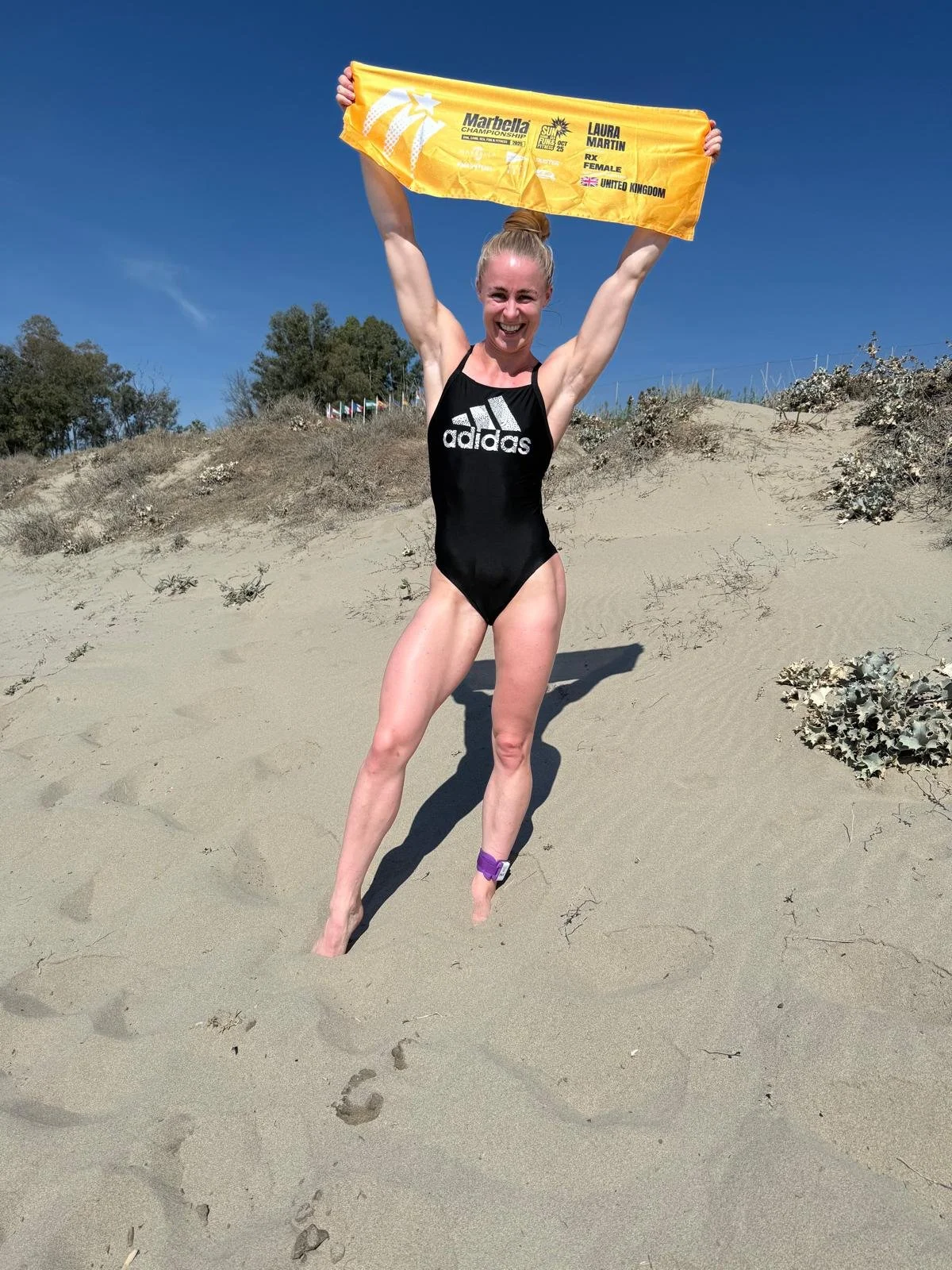
Laura Martin competing in Marbella Championship, where swimming formed part of a wider multi-discipline challenge combining endurance, strength and physical performance.
On land, strength is reassuringly visible. It can be lifted, measured, repeated and improved. In water, strength has to work differently. It rewards alignment, timing and the ability to direct effort precisely. A strong body can be an enormous advantage in swimming but only once that strength learns how to work with an environment that moves in response. For even the most physically accomplished adult, that can introduce an entirely different relationship with movement.
When two forms of expertise meet
Laura Martin came to the pool with an advanced understanding of the human body. As a Level 4 personal trainer specialising in strength and conditioning and Head of Education at Gymbox, she understands adaptation, physical performance and why meaningful progress depends upon intelligent training rather than effort alone. She could already swim front crawl. Her objective, however, was changing. Preparing for open water requires more than the ability to complete lengths in a pool. A stroke needs to remain sustainable as distance increases and dependable when the environment becomes less predictable.
Laura didn't need to become ‘fit’.
She already possessed strength, discipline, body awareness and considerable physical capacity. The interesting question was how those qualities could be translated into water.
Strength behaves differently here
On land, we can push against something solid. Water moves as we move through it. This changes the relationship between effort and result. More force doesn't automatically produce more speed. Tension can increase resistance and a small change in alignment can alter the position of the entire body.
Fitness provides the capacity.
Technique determines how economically that capacity can be used.
This was where Laura's professional knowledge and NAGER London's specialist understanding of swimming began to complement one another.
There was no need to replace what she already knew about movement. Instead, the task was to translate that knowledge into a different physical language.
Precision with a purpose
Our work focused on making Laura's front crawl more sustainable. Breathing, alignment, rhythm and the relationship between propulsion and recovery were refined not for aesthetic perfection, but for a practical reason: unnecessary resistance costs energy. In swimming, precision shouldn't make movement rigid. It should remove what isn't needed. A better body position reduces the work required to travel through the water. A well-timed breath becomes part of the stroke rather than an interruption to it. An effective recovery allows energy to be directed where it contributes most. The objective wasn't simply to complete more lengths.
It was to make every length more useful.
Technical progress can initially be easy to overlook. A movement becomes quieter. The stroke begins to connect. The same distance requires less unnecessary effort and something that once demanded conscious attention gradually becomes familiar. Individually, these changes can appear modest. Together, they alter the experience of swimming.
Becoming the learner again
There is something valuable about an experienced professional becoming the student of another discipline. Laura's background meant she understood repetition, adaptation and the importance of detail. But expertise also gave her something perhaps even more useful: respect for the learning process. She didn't expect her existing fitness to solve every problem. Instead, she was willing to notice what the water was asking of her and adjust accordingly.
Physically capable adults can sometimes find swimming surprisingly unfamiliar. Someone may run, cycle, lift weights or train at a high level and reasonably expect that fitness to transfer directly into the pool. Yet swimming asks the body to organise itself in ways that have few equivalents on land. Movement is performed horizontally. Breathing has to be incorporated into the stroke. Propulsion is created in the same environment that is producing resistance.
For an accomplished athlete or fitness professional, understanding this changes the nature of the problem. Difficulty no longer automatically means that more effort is required. Movement can instead be examined, understood and refined.
And this is where Laura's existing physical intelligence became an advantage. She could recognise subtle changes, connect technical feedback with sensation and understand that improvement might come from changing the quality of an action rather than increasing its intensity.
From pool technique to open water
A swimming distance looks wonderfully straightforward when written as a number.
400 metres. 800 metres. 1,500 metres. 2,000 metres.
Open water makes those numbers more interesting.
There are no tiled lines beneath the swimmer. Conditions change. Other swimmers may be close. Sighting alters the familiar position of the stroke and attention has to extend beyond the movement itself. Preparation therefore cannot simply consist of accumulating enough lengths to prove that the distance is possible. Distance needs to be supported by something dependable: a stroke that remains organised and economical as the metres accumulate. This is where the swimming pool becomes particularly valuable. Its predictability allows technical changes to be observed, repeated and refined. The swimmer can establish movement patterns until they require less conscious management, creating greater capacity to deal with the variables that open water will eventually introduce.
The pool cannot reproduce open water.
It shouldn't try to.
Its value is precisely that it removes many of those variables and gives the swimmer the opportunity to build something reliable before encountering them.
That is why, at NAGER London, we return to a simple principle:
Open Water Starts in the Pool.
When the lane ropes eventually disappear, the swimmer takes more than fitness into open water. They take their technique. And with it comes something equally valuable: a familiar movement to return to when conditions, surroundings or attention change.
Confidence built on understanding
Open-water confidence isn't simply the belief that the distance can be completed. There is another kind of confidence that comes from knowing how you are going to swim it. A swimmer who understands their own technique has reference points. They recognise when tension is beginning to appear, when rhythm has changed or when movement is becoming unnecessarily expensive. That awareness makes adjustment possible. Laura's preparation reflects this distinction. The distance remains important, but the deeper development lies in creating a front crawl she increasingly understands and can rely upon. That confidence is not based on hope that fitness will carry her through. It is grounded in preparation.
A different expression of strength
Laura's development isn't a story about overcoming weakness. That would misunderstand where she started. It is about extending an already sophisticated understanding of physical performance into an environment where strength has to be applied differently. The strength, fitness and discipline were already there. Swimming asks for those qualities to be organised through alignment, timing, technical awareness and economy of movement. For someone whose professional world is built around understanding the body, that presents an interesting challenge. The question is no longer simply what the body is capable of producing, but how effectively that capacity can be translated into movement through water. And perhaps this is where the two disciplines meet most clearly. Strength and conditioning develops physical capacity. Swimming provides another environment in which that capacity must be understood, adapted and applied with precision. Laura isn't leaving one form of expertise behind to acquire another. She is expanding the ways in which she can use what she already possesses. That is what makes her preparation for open water particularly interesting. The distance is important, but so is the process of discovering how strength, technique and awareness can work together when the environment itself is moving in response.
On land, strength can be lifted, measured, repeated and improved.
In water, strength reveals itself in how precisely that capacity can be used.
Laura Martin is a Level 4 personal trainer specialising in strength and conditioning and Head of Education at Gymbox. Find out more about Laura and her work at Laura Martin Fitness. https://www.lauramartinfitness.co.uk