
When swimmers think about propulsion in front crawl, they often focus on the arms. In many ways, that is correct. The majority of forward movement comes from the upper body rather than the legs.
However, that does not mean the kick is unimportant.
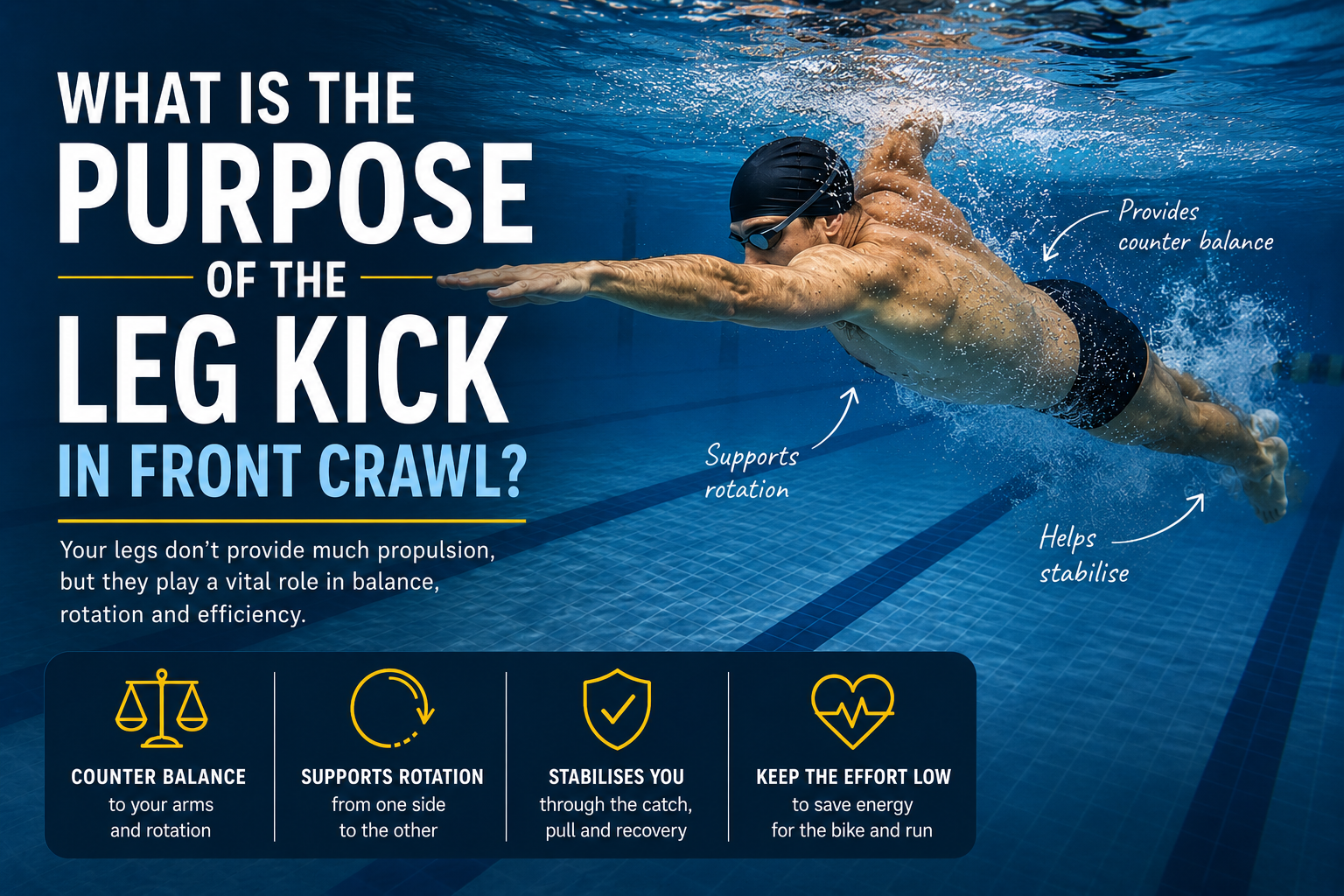
Your legs provide more support to the stroke than many swimmers realise. While they contribute a relatively small amount of propulsion, they play a vital role in helping you balance, rotate and stabilise your body in the water.
Think of the kick as a counterbalance to the movement of the arms and rotation of the torso.As you rotate from side to side and move through the catch and pull phases of the stroke, the legs help create stability behind you. They provide something to press against and help connect one side of the stroke to the other.
Without an effective kick, many swimmers feel disconnected through the water. The stroke can become less stable, less controlled and often more tiring.
This is particularly important for triathletes.
In triathlon, the goal is rarely to generate maximum propulsion from the legs. After all, you still have a bike ride and a run ahead of you. Excessive kicking can quickly increase heart rate and fatigue the muscles that will be needed later in the race.
For this reason, many triathletes aim to keep the kick light and economical.
A common misconception is that a four-beat or six-beat kick automatically means a high level of effort. In reality, a swimmer can maintain a continuous four-beat or six-beat kick while using very little energy. The rhythm remains present, but the effort stays low.
The kick pattern may also change throughout a swim.
It can vary depending on whether you are breathing, which side you are breathing to, how hard you are working and where you are within a race. A swimmer may move from a four-beat kick to a six-beat kick and back again as conditions and demands change.
The key is not necessarily the number of kicks. The key is the effort behind them.
If you watch elite triathletes racing over Olympic distance, you will often see a consistent six-beat kick throughout much of the swim. To an observer it may appear that they are kicking hard, but the effort is usually controlled. The kick is there to support balance, rhythm and body position rather than to drive the entire stroke.
This distinction matters.
Your legs do not need to be passive, but neither do they need to work excessively. An effective kick is one that contributes to stability, timing and efficiency while conserving energy for the rest of the race.
In many cases, the best kick is not the one that feels the most powerful. It is the one that allows the rest of the stroke to work more effectively.