
SPEEDO Fins, Through a Coaching Lens
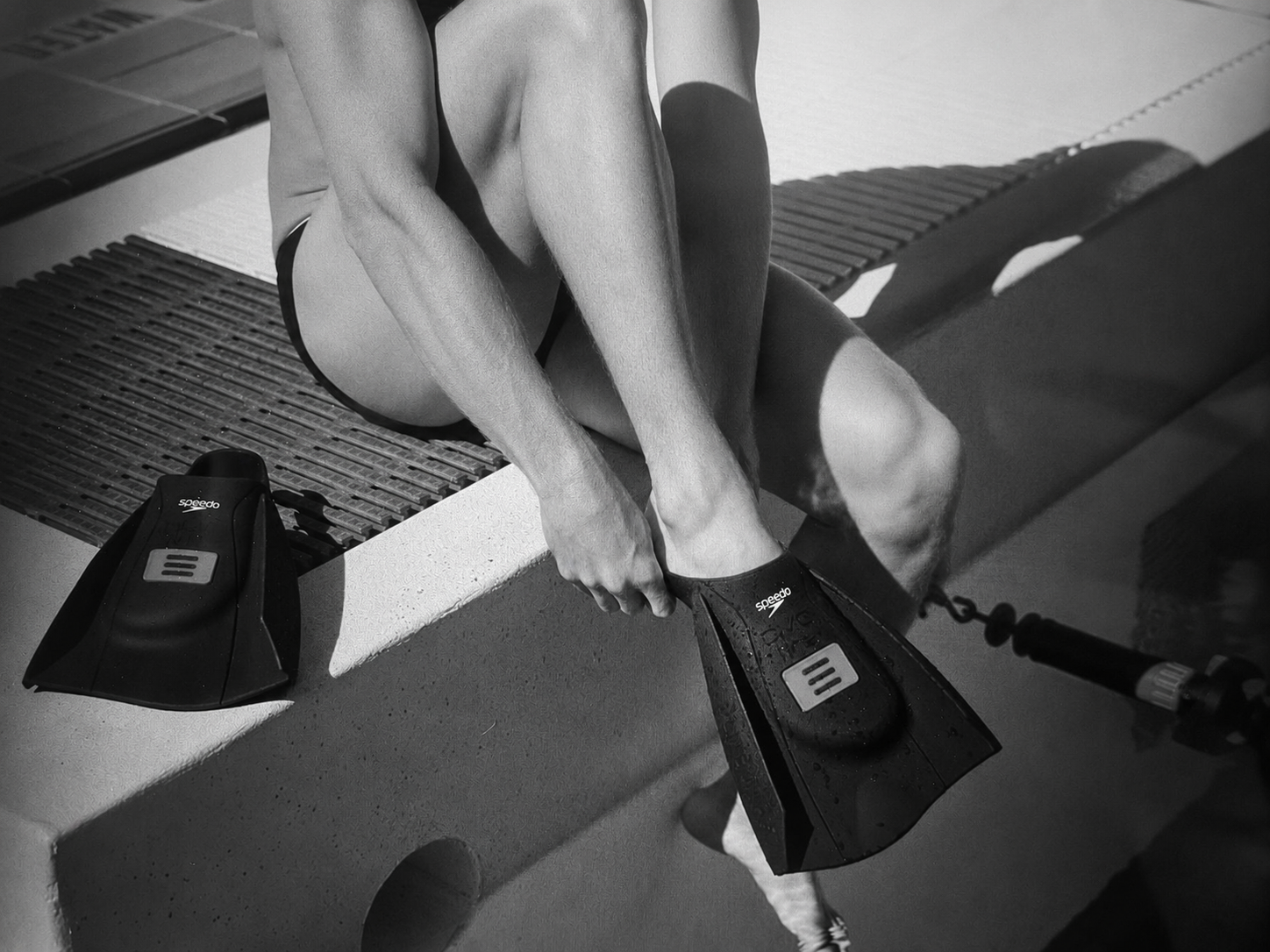
swimming-training-fins-nager-london.jpg
What a pair of fins can reveal about the way you swim
Put a pair of fins on a swimmer and something happens almost immediately.
They move faster through the water.
For many swimmers, that is the attraction. There is suddenly more propulsion, greater momentum and often the rather wonderful sensation of moving through the water with less effort. But speed isn't the part that interests me most.
I am interested in what the fins reveal.
A pair of fins changes the swimmer's relationship with the water. Pay attention to that change rather than simply enjoying the additional speed. Fins can tell you a surprising amount about your kick, your ankles, your alignment and even the way you understand propulsion. The blade gives the foot a larger surface area to work with, making the water's response to movement easier to feel. Good movement is amplified but inefficient movement can be amplified too. That is what makes fins so interesting as a coaching tool. Swimming equipment should not simply help you do more. Sometimes its most valuable role is to help you feel more.
Equipment should have a job
A swimmer's kit bag can become surprisingly full. But owning equipment and understanding equipment are two quite different things.
Whenever a training aid is introduced, there should be a reason for it. Are we trying to exaggerate a sensation? Isolate a movement? Add resistance? Perhaps remove one complication so the swimmer can concentrate on another or allow the body to experience a position it hasn't yet learnt to create independently?
Without that purpose, putting on fins can become simply doing a set with fins. You swim faster. You finish the set. You take them off.
Opportunity missed.
The useful question isn't simply “What did I do with the fins?”
It is:
“What did the fins allow me to understand that I couldn't feel as clearly before?”
Fins don't just make your feet bigger
At their simplest, fins increase the effective surface area acting against the water. But what the swimmer experiences is far more interesting. The additional propulsion increases the speed at which the body travels through the water. Suddenly, streamline feels different. Resistance feels different. The relationship between a relatively small movement at the feet and movement of the entire body becomes much more noticeable.
This is where I want the swimmer to become curious.
What changed?
Not simply “Am I faster?” but what happened to your body position? Your rhythm? Where did you feel the pressure? Did you suddenly feel longer through the water? Did the movement become easier, or did the fins expose something uncomfortable?
Those sensations contain information.
Your kick starts higher than your feet
One of the misconceptions I frequently see is that kicking is something the lower leg does. It isn't. An effective flutter kick is part of a chain of movement through the body. The hip, leg, ankle and foot all contribute. There will naturally be movement at the knee but there is an important difference between a knee that participates in the movement and a kick that is driven predominantly from the knee.
Put fins onto a swimmer who predominantly bends and kicks from the knee and the increased surface area can exaggerate that movement. Instead of directing force effectively through the water, some of that energy becomes unnecessary movement.
Suddenly, the equipment is talking.
The answer isn't necessarily kick harder.
It may be:
Understand where your kick is coming from.
That is a much more useful conversation.
Your ankles have something to say too
Ankle mobility plays an important role in an effective swimming kick. The movement doesn't simply end at the leg. It continues through the ankle and into the foot, where it finally meets the water. A relaxed, mobile ankle allows that movement to flow more naturally and the foot to interact with the water more effectively. This is why someone can have exceptionally strong legs and still be surprised by how little propulsion their kick produces. Runners and cyclists are a good example: strength developed on land doesn't automatically translate into efficient movement in water. Fins make this relationship much easier to recognise because they extend the surface of the foot and amplify its interaction with the water. A swimmer with a stiff or tense ankle may feel as though they are fighting the fin. Relax some of that tension and something changes: the movement can travel more naturally through the leg and ankle and into the blade, allowing the fin to work with the water rather than against it.
But this isn't about forcing greater flexibility. It is about having enough mobility without unnecessary tension. It isn't simply about how strongly you kick. It's about how effectively that movement reaches the water. This is one of the things I find fascinating about swimming.
Sometimes improvement doesn't come from producing more effort. It comes from removing unnecessary effort.
The length of the fin matters
Not every fin belongs in a swimming training session. Long fins are familiar from diving and snorkelling. Their larger blades move more water and can generate substantial propulsion. That makes sense when the objective is efficient movement through an underwater environment. But stroke training asks something different of the body. We don't simply want the fin to propel the swimmer. We want the swimmer to retain a kicking rhythm that still has a relationship with swimming once the fins come off.
This is why blade length matters.
Longer blades generally provide greater propulsion, but they also change the rhythm of the kick. Shorter training fins allow a quicker cadence and can feel more closely connected to the natural rhythm of front crawl, backstroke and butterfly.
There is, however, no perfect length.
A swimmer who is still developing ankle mobility, or simply becoming accustomed to fins, may benefit from a slightly longer, more forgiving blade. A more experienced swimmer may want something shorter and more responsive. The appropriate choice depends on both the swimmer and what we are trying to achieve. The question, then, isn't simply whether a fin should be long or short.
It is:
What are we asking the fin to do?
The objective isn't necessarily to create the greatest possible propulsion. It is to create useful propulsion without losing the character of the movement we're trying to develop. Sometimes less blade gives us more information.
Stiffness changes the conversation too
Length isn't the only thing that determines how a fin feels. Two fins of a similar size can behave very differently depending on their material, stiffness, blade shape and construction. A softer blade may bend more readily and feel more forgiving. A stiffer blade can provide greater resistance and more pronounced feedback, but it also asks more of the swimmer. And more demanding doesn't automatically mean better. If a fin is too stiff for the swimmer's current strength, ankle mobility or technique, the body may begin to compensate. The knee may bend more, the ankle may become rigid or the kick may become unnecessarily large. At that point, the equipment is no longer supporting the movement we intended to develop. This is why the most sophisticated fin isn't automatically the right fin.
The equipment has to suit both the swimmer and the purpose.
Fit is part of that relationship too. The foot should feel secure without the swimmer having to curl their toes or create tension simply to keep the fin in place. A fin should become part of the movement, not something the swimmer has to manage.
Speed can teach you about streamline
There is another reason I like fins as a teaching tool.
Speed makes inefficiency harder to ignore.
As the swimmer travels faster, a lifted head, a broken line through the body or unnecessary movement becomes increasingly costly. The water responds immediately.
But find a cleaner line and the experience changes. When the body becomes long and aligned, the swimmer begins to experience what it feels like to carry speed through the water rather than continually manufacturing it. That feeling matters. A swimmer can be told a hundred times to “streamline”. Feeling what an efficient line actually does to movement through the water is something else entirely. And once the body has experienced that sensation, we have something to return to.
But fins can also lie to you
There is another side to all of this.
Fins can reveal weaknesses, but they can also disguise them. Additional propulsion can lift a swimmer's body position. It can carry them through a point in the stroke where momentum would normally disappear. A weak kick can suddenly feel effective and an inefficient swimmer can feel wonderfully streamlined. That isn't necessarily a bad thing. Sometimes I want a swimmer to experience a position, rhythm or speed they cannot yet create independently. Feeling it gives us something tangible to work towards. But we have to recognise:
Who created that improvement — the swimmer or the equipment? The sensation may initially be borrowed. The real learning begins when we ask whether the swimmer can reproduce some of it without the fins.
The most important moment comes when the fins come off
This is the part I would like swimmers to pay much more attention to.
Swim with the fins. Feel the speed. Notice the pressure against your feet. Notice your ankle, where the kick originates and the line of your body.
And then:
Take them off.
Now swim again. Don't immediately chase the speed you had with the fins. Instead, try to reproduce the information they gave you. Can you keep some of that length through the body? Can you retain the rhythm? Can the ankle remain relaxed? Can you create propulsion without forcing the movement? Can you remember what efficient movement felt like? If something remains after the equipment has gone, then the fins have done more than make you faster. They have taught you something.
Not every fin asks the same question
Speedo makes fins for different levels and training purposes. But the real question isn't which fin makes you faster it's what the fin changes in your movement and what remains when you take it off.
This is where equipment design becomes genuinely interesting. Fin length, stiffness, blade geometry, material and fit all change how the swimmer interacts with the water.
The current Speedo × DMC range is a good example because it doesn't treat the training fin as one universal object. The collection ranges from more general-purpose and flexible designs to performance-oriented fins, with differences in blade construction and technology influencing how the fin behaves in the water.
But that doesn't make the most advanced model automatically the best choice. For me, the more interesting question is: “What will this particular fin ask this particular swimmer to feel?” A beginner learning to understand propulsion, an adult developing ankle mobility and a competitive swimmer working at speed may all need something different from the equipment. That's where product design becomes relevant to coaching. Not because technology replaces technique.
Because, when chosen intelligently, technology can help us understand technique.
Your fins are talking to you
Water is already an extraordinary feedback system. It tells you when you're creating resistance, when you're balanced and when force is travelling somewhere it shouldn't.
Fins simply turn up the volume.
Used without thought, they make you faster. Used with purpose, they can make you more aware.
At NAGER London, that is where equipment becomes interesting not simply because of what it does for the swimmer but because of what it allows the swimmer to understand.
Eventually, the fins come off.