
The Flow Form: 4 Strokes. 30 Days. Genuine Competence.
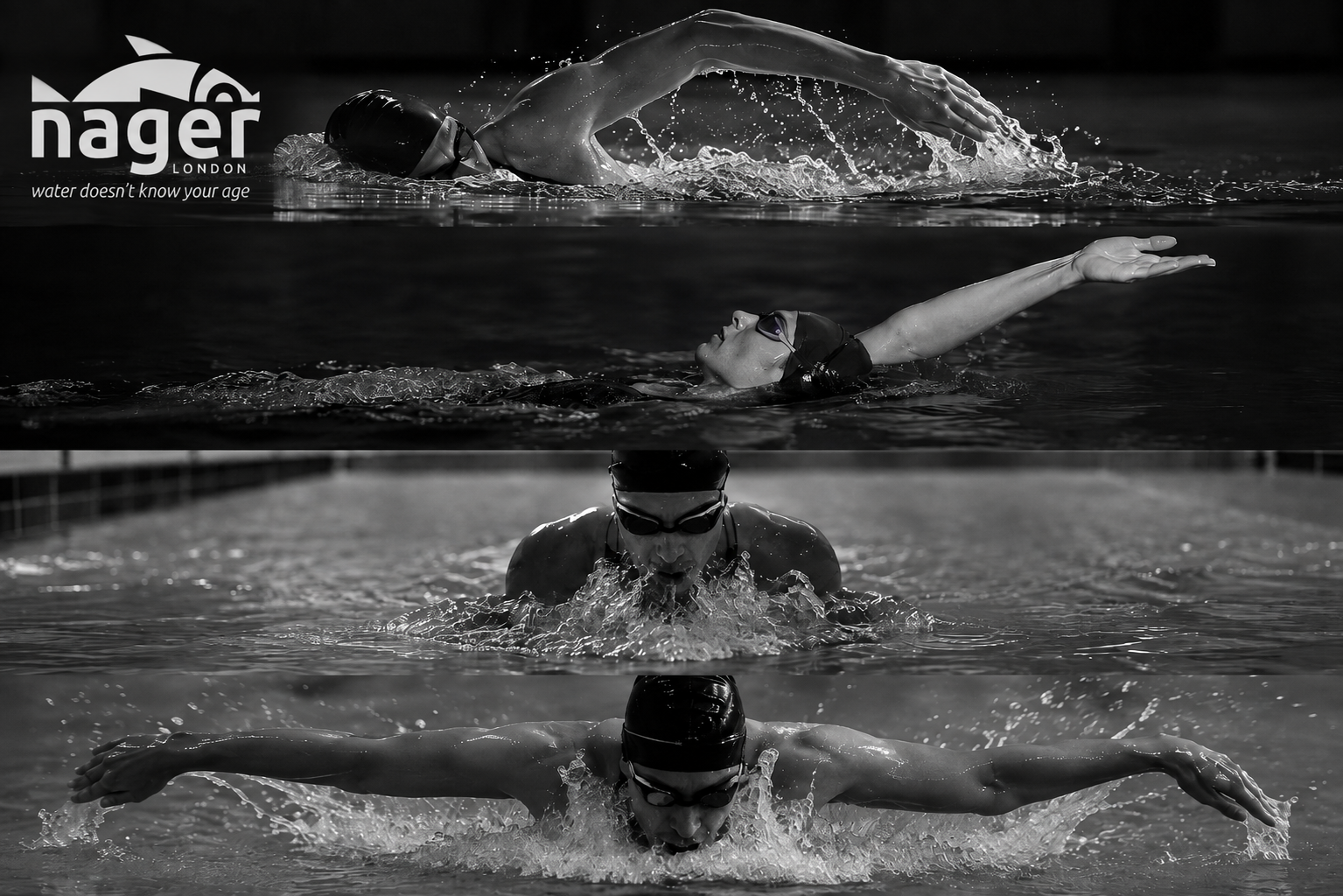
Learn all four swimming strokes with NAGER London.
Front crawl. Backstroke. Breaststroke. Butterfly. What if learning all four was more achievable than you thought?
Four strokes. Thirty days.
It sounds ambitious.
Perhaps even unrealistic if you have spent years believing that good swimmers started young, that butterfly belongs to competitive swimmers or that learning a new stroke simply takes a very long time. But what if the limitation isn't your age or ability? What if you simply haven't yet found the way of learning that works for you?
With the right starting point, consistency and coaching, developing genuine competence across all four swimming strokes within 30 days can be achievable. Not perfection. Not four strokes hurriedly demonstrated so they can be ticked off a list. Genuine competence. The point at which you are no longer simply copying movements. You begin to understand them. And once swimming starts to make sense, what seemed difficult can become surprisingly possible.
Perhaps you are more capable than you think
Adults often arrive at swimming with a firmly established idea of what they can and cannot do. I'm not coordinated enough. My legs always sink. I've never been able to breathe properly.
Butterfly? Absolutely not.
I should have learnt when I was younger. Repeat those thoughts for long enough and they begin to feel like facts. But water has no knowledge of your history.
It doesn't know whether you learnt at six or sixty. It doesn't know whether someone once told you that you weren't a natural swimmer. It simply responds to what your body is doing now. Change the relationship between the body and the water and the experience can change with it. Sometimes remarkably quickly.
Why learn all four strokes?
There is something liberating about not being confined to one way of swimming. Front crawl brings rhythm and continuous movement. Backstroke changes your orientation and relationship with balance. Breaststroke introduces an entirely different coordination of propulsion and glide.
And butterfly often dismissed by adults before they have even attempted it opens another understanding of rhythm, timing and whole-body movement.
Learning all four doesn't simply give you four different ways of getting from one end of the pool to the other. It gives you a broader language of movement in water.
You stop thinking of yourself as somebody who can do a bit of front crawl or only swims breaststroke.
You begin to think like a swimmer.
Why 30 days?
Thirty days isn't a magic number. It creates something much more useful:
Momentum.
When swimming experiences are separated by long gaps, part of each return to the water can be spent rediscovering what had begun to make sense previously. Continuity changes that. A sensation is still familiar enough to recognise. One piece of understanding can build upon another. Confidence has an opportunity to settle rather than repeatedly being rebuilt. Thirty days isn't about putting pressure on the swimmer to learn faster. It is about giving learning enough continuity to move forward.
This isn't a crash course
There is an important distinction between learning quickly and rushing. The Flow Form isn't designed to squeeze four sets of stroke instructions into a month. Being shown where to put your arms and legs is relatively straightforward. Understanding how to make those movements work in water is something else. Competence begins when the swimmer can reproduce a movement without constantly waiting for instruction. When something feels wrong and you begin to recognise why.
When an adjustment doesn't require the entire stroke to be rebuilt. When the movement starts to belong to you. Thirty days isn't about producing four perfect strokes.
Swimming always has another level. It is about building a foundation strong enough to continue from.
Four strokes don't have to mean four separate journeys
Front crawl, backstroke, breaststroke and butterfly are technically very different. But they all happen in the same environment.
Water.
And water doesn't change its rules because the name of the stroke has changed. This is where The Flow Form approaches learning differently. The framework isn't based on pushing every swimmer through an identical sequence of exercises. Different bodies arrive with different experiences, habits, strengths and ways of understanding movement. The important question is not simply:
What stroke comes next?
It is:
What does this swimmer need next? That distinction allows learning to become individual rather than formulaic. The details belong in the coaching itself.
More practice isn't always more progress
Swimming improvement is often associated with doing more. More lengths. More kicking. More drills. More effort. But repetition has an interesting characteristic:
It reinforces whatever you repeat. If the movement is helping you, repetition can be extremely valuable. If it isn't, doing another twenty lengths doesn't necessarily solve the problem. This is where skilled coaching changes the experience. Sometimes progress requires repetition. Sometimes it requires a different explanation.
Sometimes the body needs to experience something before the mind understands it. And occasionally improvement comes from doing less, not more. The value lies in knowing the difference.
What does genuine competence look like?
It isn't measured simply by reaching the other end of the pool. And it certainly isn't perfection. It is something quieter. You return to a stroke and can find it again.
You understand what you are trying to achieve. You begin to recognise your own movement rather than relying entirely on somebody else to tell you what happened.
You make an adjustment. You feel the difference. And increasingly, swimming stops feeling like a collection of instructions you are trying desperately to remember.
It starts to feel like something you know how to do. That is competence.
You don't need to arrive as a good swimmer
Your starting point is exactly that. A starting point. Perhaps you already swim front crawl but have never attempted butterfly. Perhaps breaststroke has been your safe stroke for twenty years. You may be physically strong but find swimming unexpectedly exhausting. Or perhaps you can swim perfectly well but have always wondered what it would feel like to learn all four strokes properly. There is no single profile of the swimmer who can make significant progress. That is why The Flow Form begins with the person in the water rather than a predetermined formula. The route may be different.
The possibility remains.
Imagine yourself 30 days from now
Imagine getting into a pool and no longer automatically choosing the only stroke you trust. You swim front crawl. Turn onto your back. Change the rhythm. Move into breaststroke. And perhaps you swim butterfly the stroke you once watched from another lane and quietly decided wasn't for you. Not perfectly.
Competently.
You know what you are doing. You understand what you are looking for. And you have enough knowledge of your own movement to continue developing it.
Thirty days earlier, some of those movements may have felt completely unfamiliar. Now they are part of your swimming.
And the question changes.
It is no longer:
“Could I learn all four strokes?”
It becomes:
“Where could I take them next?”
What could 30 days change for you?
Four strokes in thirty days is certainly a challenge. But perhaps the most interesting outcome isn't being able to say that you have learnt front crawl, backstroke, breaststroke and butterfly. It is discovering that something you had quietly placed in the category of “I can't do that” was learnable after all. That changes more than technique. It changes the way you approach the water.
4 Strokes. 30 Days. Genuine Competence.
Not a race through four techniques. An opportunity to discover how much more may be possible when you learn differently.
The Flow Form.
Water doesn't know your age — only your potential.